Super Mario World: the SNES launch title that defined the 16‑bit era
Nintendo’s landmark platformer expanded the map, introduced Yoshi, and helped define what 16‑bit polish looked like.

By GANM OLS Editorial Team
GANM OLS Editorial
Updated: March 23, 2026 at 09:15 PM
Related reads:
In the early 1990s the transition to 16‑bit gaming brought brighter colors and more expansive worlds. Super Mario World was the flagship of this revolution. Developed by Nintendo EAD and released for the Super Famicom on 21 November 1990, the game reached the United States on 23 August 1991, Europe on 11 April 1992 and Brazil on 30 August 1993. It served as a direct sequel to Super Mario Bros. 3 and introduced the beloved dinosaur Yoshi, who later starred in his own series.
Story in Dinosaur Land
After saving the Mushroom Kingdom, Mario and Luigi travel to Dinosaur Land for a vacation. Their rest is interrupted when Princess Toadstool disappears. While exploring the forest, the brothers find a huge egg; it hatches into Yoshi, who explains that Bowser and his Koopalings have trapped his dinosaur friends in eggs. Armed with a magical cape, Mario sets off with Luigi and Yoshi to rescue the princess and free Yoshi’s friends. Their quest leads them across Dinosaur Land to the Valley of Bowser, where Mario faces Bowser in his Koopa Clown Car. Bowser is defeated, Princess Toadstool is freed, and the heroes return to Yoshi’s House to watch the baby Yoshis hatch.
Mechanics and gameplay
While retaining the world‑map structure of Super Mario Bros. 3, Super Mario World vastly expands it: rather than segmented worlds, the map has interconnected routes and multiple exits. Each 2‑D level challenges Mario (or Luigi) to reach the Giant Gate before time runs out. Several new movements and systems enrich the formula:
Spin jump: a whirling jump that breaks certain blocks and enemies.
Running and carrying: holding the X or Y button makes Mario dash and carry items; he can even carry objects underwater and swim quickly.
Bonus Stars & mini‑games: touching the moving tape on the Giant Gate awards Bonus Stars; 100 stars grant access to a mini‑game for extra lives.
Midway Gates: checkpoints that also power up Mario to Super Mario.
Item Stock: an inventory slot where Mario stores a spare power‑up; it drops automatically when he takes damage.
Power‑ups
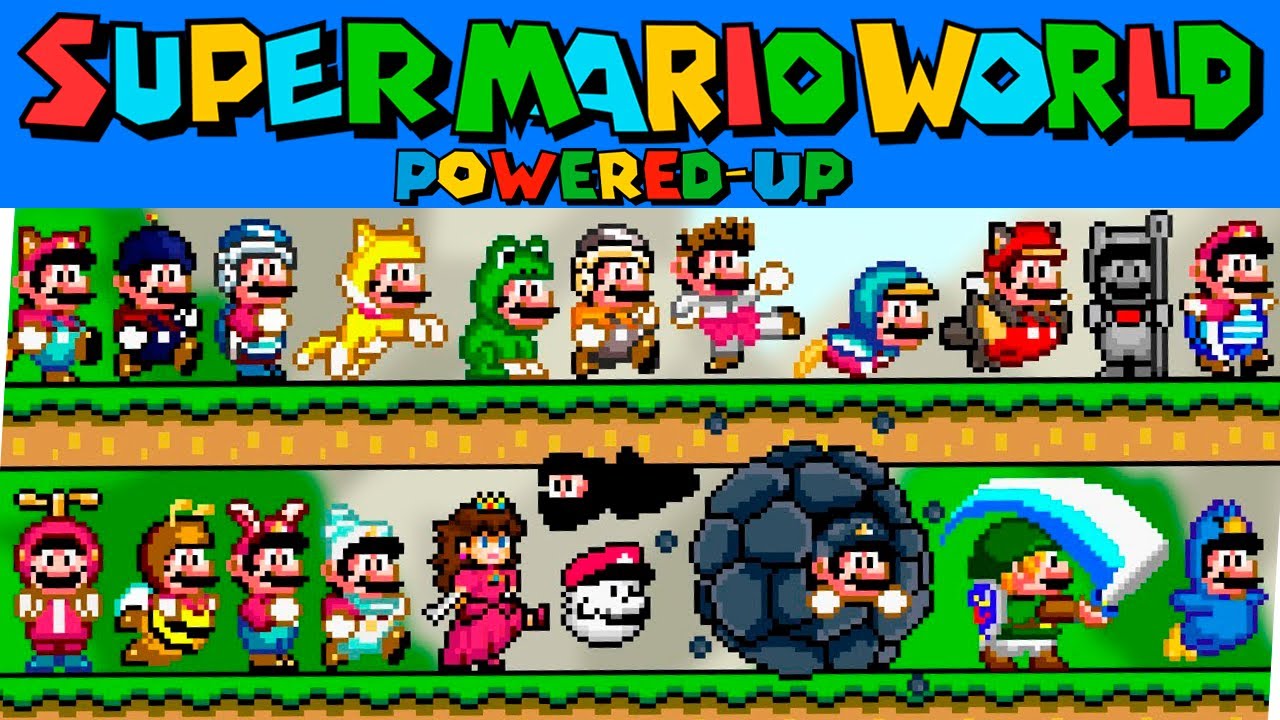
Beyond the familiar Super Mushroom and Fire Flower, the new Cape Feather gives Mario a cape that lets him glide, fly, and dive‑bomb enemies. The game also introduces Yoshi as a rideable companion; when mounted, Mario gains the ability to swallow enemies and spit projectiles. Different colored Yoshis grant unique powers: Red Yoshi spits three fireballs with any Koopa Shell, Blue Yoshi can fly regardless of shell color, and Yellow Yoshi produces shockwave sand clouds when landing.
World structure
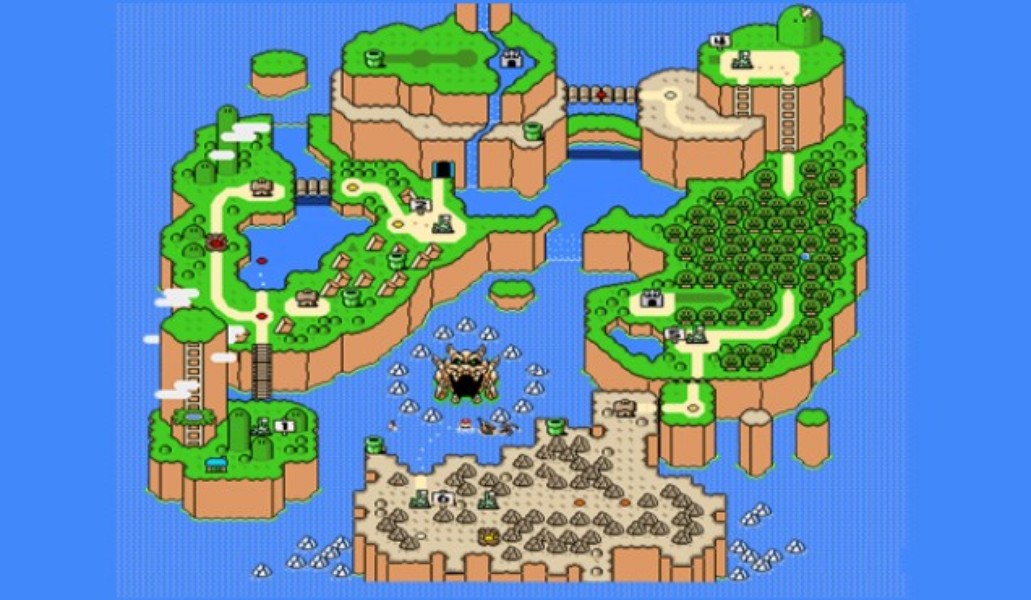
The adventure spans seven main areas and two secret zones. Environments range from the grassy Yoshi’s Island to the maze‑like Forest of Illusion that requires discovering secret exits to progress. Each world contains a Switch Palace that converts dotted blocks into solid Exclamation Mark Blocks, creating essential platforms. Highlights include:
Donut Plains: introduces the first Ghost House and levels with multiple exits; players frequently use the Cape Feather.
Vanilla Dome: an underground cavern with lakes, lava pools and the Red Switch Palace.
Twin Bridges: sky‑oriented region featuring bridges and both ground and aerial stages.
Forest of Illusion: a perplexing forest where standard exits loop back on themselves until secret exits are found.
Beyond the main worlds lie two secret areas:
Star World: accessed via Star Roads, this bonus world requires finding keys and keyholes hidden in various stages. Mini‑Yoshis of different colors appear here.
Special Zone: unlocked after completing all secret exits in Star World, this linear area offers extremely tough stages with no checkpoints. Clearing the Special Zone triggers a Fall aesthetic that recolors the world map and enemy sprites.
Two‑player mode
Super Mario World includes an alternating two‑player mode. Player 1 plays as Mario and Player 2 as Luigi; when one fails a course, the other takes a turn. Players may share lives on the map screen. Yoshi cannot enter castles, fortresses or Ghost Houses but waits outside for the player to return.
Legacy, re‑releases and modern availability
The game’s critical acclaim and commercial success cemented it as a hallmark of Nintendo’s catalogue. It introduced mechanics and characters that influenced subsequent games, and Yoshi’s popularity spawned Super Mario World 2: Yoshi’s Island in 1995. Over the years Super Mario World has been reissued multiple times: as part of the compilation Super Mario All‑Stars + Super Mario World (1994); as Super Mario Advance 2 for Game Boy Advance; and on the Wii, Wii U and New 3DS Virtual Console services. It is pre‑installed on the SNES Classic Edition and is included in the Super Nintendo Entertainment System – Nintendo Classics library. An alternate version titled “Give the world a whole new look!” released in 2022 begins with the Fall palette active, 99 lives and a Cape Feather.
Modern players can legally enjoy the game through official releases: the SNES Classic Edition (Super Nintendo Mini), the Nintendo Switch Online membership, and digital re‑releases on compatible systems. These options preserve the authenticity of the original while supporting the rights holders.
Conclusion
Over thirty years since its debut, Super Mario World remains a milestone in video game history. Its expansive map, introduction of Yoshi, deep power‑up system and abundance of hidden exits set a benchmark for platformers that is still admired today. The journey through Dinosaur Land continues to captivate new audiences and inspire nostalgia among longtime fans.